


Over 2500 years of history are condensed into this amazing tour through the history of Ibiza, where the stops open a window on the civilisations that inhabited our island and built its unique character. Coming?
Doing this tour of Ibiza following the key remains of each era is like reading a history book written in stone by the Phoenicians, Carthaginians, Romans, Muslims and Catalans. Layer upon layer, they gradually built the history and identity of Ibiza, which preserves a unique cultural heritage as seen in its folklore, architecture and cuisine. A priceless legacy that continues to surface through new digs and archaeological findings in a history that has yet so much to reveal.
Tour of Ibiza’s origins: from the Phoenicians to the Muslims
Four stops to learn about the old civilisations that came to the island and built the foundations of their economy and identity.
Sa Caleta: the Phoenician origins
The trip starts at the archaeological site of Sa Caleta, by Es Bol Nou beach and the new Visitor Centre that was opened this year. Founded around 650 BC, it was the first Phoenician settlement on the island. Part of Ibiza’s World Heritage declaration, the remains consist of a set of dwellings and workshops that reveal the life of the Phoenicians, who were expert seafarers and traded in salt, pottery and metals. After living on this settlement for about 50 years, the colony preferred to move to a more convenient location and this meant the foundation of the city of Ibiza, which they called Ibosim.
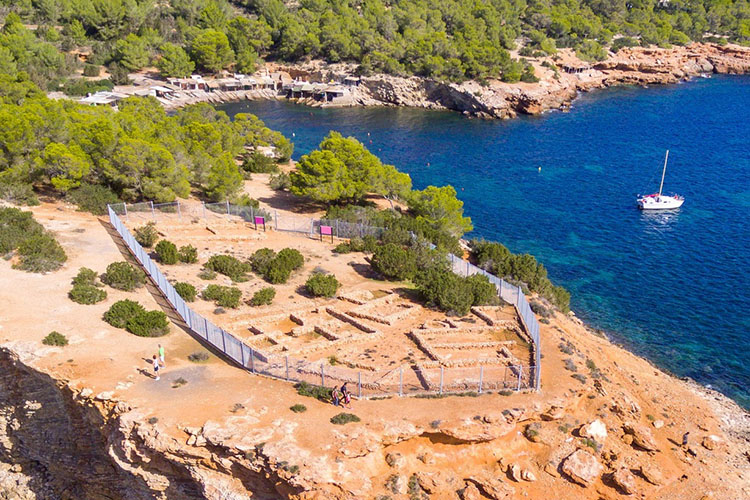 Sa Caleta. © santjosep.net
The city of the dead: Necropolis of Puig des Molins
The next stop is outside the city walls surrounding the citadel of Ibiza. Started by the Phoenicians in the 7th century, more than 3000 hypogea make it the largest and best preserved necropolis in the Mediterranean. A must-see on the island that is also part of Ibiza’s recognition as World Heritage.
S’Argamassa: the Romans and their factories
After the Second Punic War, the island became part of the Roman province of Hispania and was known as Ebusus, even if it managed to keep its autonomy and Punic culture. These were the pioneers in hydraulic engineering, to whom we owe the aqueduct of s’Argamassa, near Santa Eulària des Riu, remains that show how they channelled water to use it in a fish factory, where they are thought to have salted fish. The Romans consolidated the trade in wine, wool, figs, salt and oil and laid down a network of roads that would later influence the rural layout of the island.
 Necropolis of Puig des Molins. © MACE
Balàfia: the Muslim Yabisah
After the downfall of the Roman Empire, Ibiza was conquered by the Muslims in the 9th century and became Yabisah. Under their Andalusian domain, they developed an advanced farming system with waterwheels, canals and patches that still shape the countryside landscape to this day. The capital was arranged around the medina where Dalt Vila stands today and small country villages called “alquerías”.
One of the most remarkable examples of this era was the Balàfia village near Sant Llorenç de Balàfia. This set of fortified houses with watchtowers is the best testament to the Muslim settlement on the island. The Muslim legacy also lives on through the toponyms (Benimussa, Benirràs, Arabí) and in the way plots of land are split in the countryside, which kept the layout of the old farmhouses even after the Christian conquest.
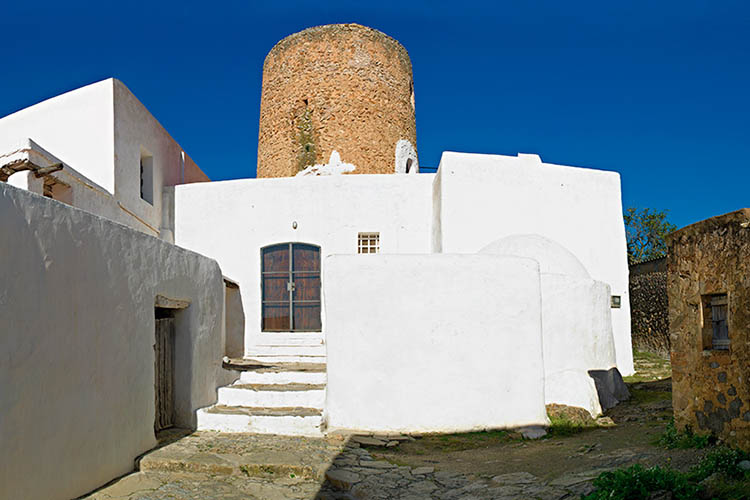 Balàfia village. Picture: Ibiza Travel
Tour of Ibiza’s past: from the Catalans to the Corsairs
The need to defend itself against the threats coming through the Mediterranean Sea define the next stops on this tour through Ibiza’s past.
Dalt Vila: from the Catalan conquest to the building of city walls
The Catalan conquest in 1235 meant the annexation of the island to the Crown of Aragon, adding another layer of history to the city of Ibiza. They built churches and Gothic palaces on top of the old Muslim medina, but the current physiognomy of Dalt Vila was consolidated in the 16th century when Philip II of Spain ordered the city to be fortified to defend it from Ottoman and Berber attacks. This resulted in the monumental walled area of Dalt Vila, designed by the engineers Giovanni Battista Calvi and Jacobo Paleazzo. It is considered one of the best preserved Renaissance citadels in the Mediterranean and was thus declared World Heritage.
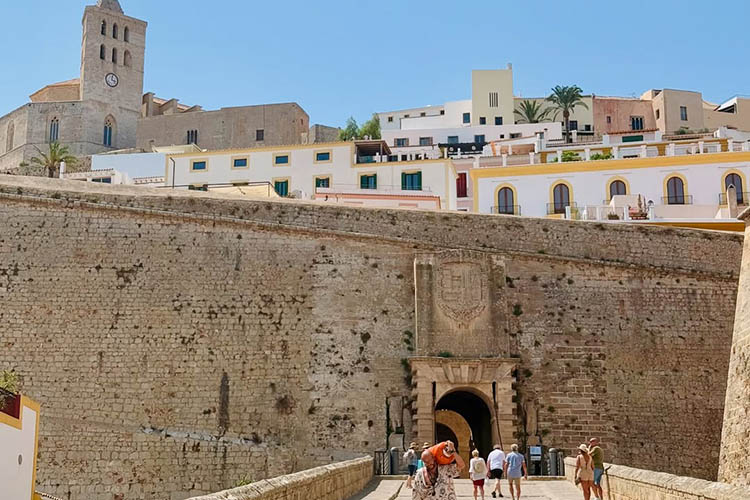 The monumental walled area of Dalt Vila. @ Ibiza Travel
Puig de Missa: a fortified church to defend itself from pirates
During the 16th and 17th centuries, the threat coming from the Berber corsairs forced the islanders to not only fortify their capital, but also the coast and inland. This era produced fortified churches, temples that had a double function: religious and defensive, with thick walls, barely any openings and towers that were used as shelter and watchtowers. The main example of this is in Santa Eulària des Riu, the historic site of Puig de Missa. The churches of Sant Jordi de ses Salines, linked to the protection of the salt flats; and the church of Sant Antoni de Portmany, with its robust watchtower, are other examples of the oldest fortified churches on the island.
The villages of the Archbishop Abad y Lasierra.
In the late 18th century, the Archbishop Manuel Abad y Lasierra, first bishop of Ibiza, led a huge restructuring of the land. Aware of the isolation suffered by many rural areas, he promoted the creation of new villages around the churches to encourage community life and access to religious services. However, his idea failed as the farmers preferred to stay on their land, but this initiative gave way to the temples of Sant Carles, Santa Gertrudis, Santa Agnès, Sant Francesc, Sant Agustí, Sant Rafel, Sant Llorenç and Sant Mateu. These became meeting points that, in some cases, ended up developing into villages over the 20th and 21st centuries.
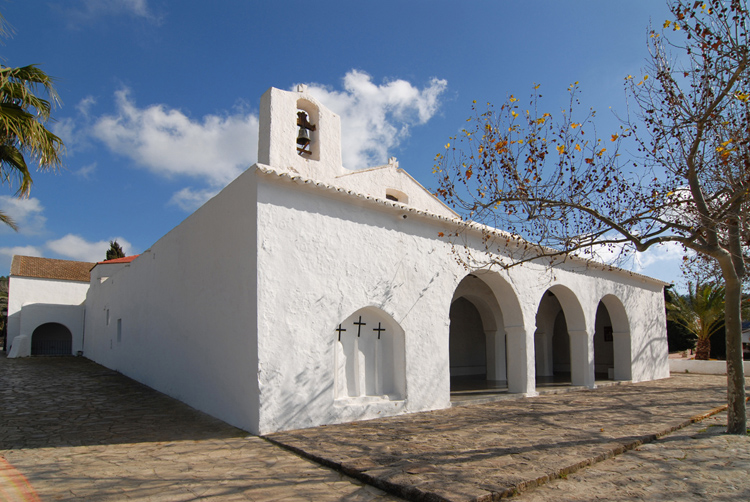 Sant Carles. © Visitsantaeulalia.com
A hotel to explore Ibiza’s past and present
Our location in Es Canar, the eastern coast of Ibiza is perfect to explore the history, beaches, nature and food of Ibiza. Book your room at Hotel Anfora and enjoy a comfortable and modern hotel in Ibiza with pool, gym, restaurant and hot tub. Book directly from our website,
Main picture: Torre d'en Valls or de Campanitx / Ibiza.travel


